Best Solana Wallet
Every Solana wallet talks to the same chain through an RPC endpoint, so the feature lists look alike. What actually separates them is how well they show you what you are about to sign — which is where Solana balances are lost.
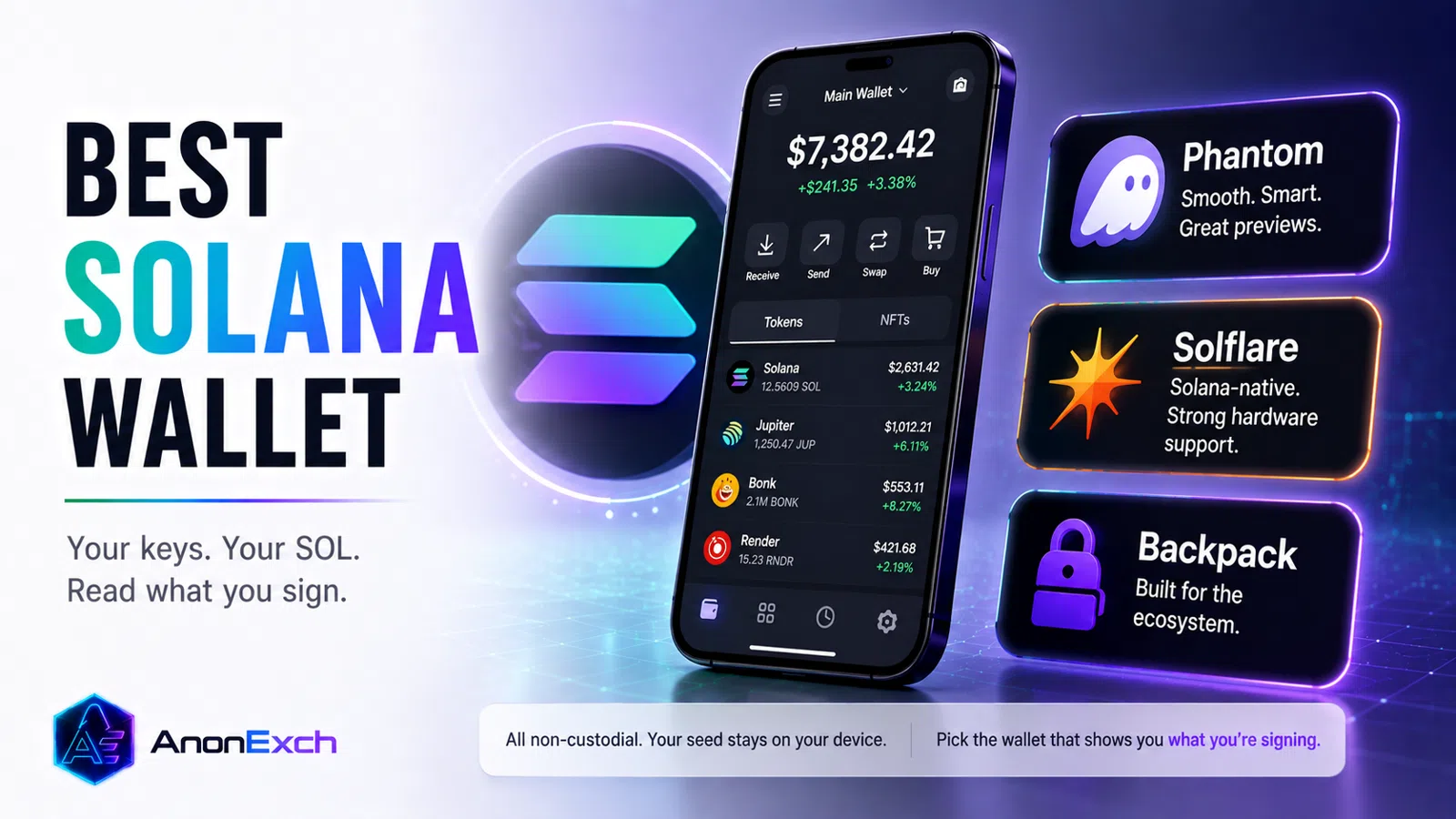
Short answer: Phantom if you want the most polished option and the widest dApp support, Solflare if you want something Solana-native with strong hardware-wallet handling, Backpack if you live in the ecosystem. All three are non-custodial, all three keep your seed on your device, and honestly the difference between them matters less than the two things below.
Because on Solana, wallets are not usually what loses people money. Signing is.
Why the wallets look so similar
A Solana wallet does not hold your balance — the chain does. The wallet holds a key and asks an RPC endpoint for everything else: balances, token accounts, transaction history, and the current state it needs to build a transaction. Every wallet on this list does that, most of them through the same handful of infrastructure providers.
Two consequences follow.
Your RPC provider sees you. It learns your IP address and the addresses you are asking about, and can link them. Solana's chain is fully public anyway, so this is not the disaster it would be on Monero — but it does connect a real network identity to a set of addresses, which the chain alone does not do. Every wallet here lets you change the endpoint, and almost nobody does.
Feature parity is cheap. Anything one wallet can show, another can. So the thing worth comparing is not the feature list; it is what happens in the half-second before you approve something.
The wallets
Phantom is the default recommendation and deserves to be. It has the best transaction-preview in the category — it simulates what a transaction will do and tells you in plain language which tokens are leaving your wallet, which is precisely the information you need to catch a malicious one. Browser extension and mobile, and it handles several chains besides Solana now.
Solflare is Solana-only and has been since early on. Its hardware-wallet support is the most thorough, and it exposes staking and account details other wallets hide. A good fit if Solana is the whole of what you do.
Backpack is the newest of the three and the most ecosystem-native. Capable, actively developed, and a smaller user base than the other two — which cuts both ways for a wallet.
All three are non-custodial: your seed phrase is generated on your device and never sent anywhere. Losing it loses the wallet, and no one can restore it for you.
The two traps that are specific to Solana
Rent. Solana charges a small refundable deposit to keep an account open, and holding any token means opening a token account for it. So a wallet with tokens but no SOL cannot transact, and a brand-new wallet needs a little SOL before it can receive most things usefully. The deposit comes back when the account is closed. It surprises people once.
Drainers. This is the real one. Solana's low fees and fast confirmation made it the most attractive chain for wallet-drainer campaigns: a fake mint page, an airdropped token whose "claim" site asks you to sign, a compromised project account posting a link. The signature you give does not move a fixed amount — it can authorise a transfer of everything.
Three habits defeat almost all of it. Read the simulation your wallet shows you and stop if it lists tokens you did not expect to send. Treat any token that appears in your wallet unbidden as bait and never interact with its links. And keep the balance you actually care about in a separate wallet that never touches a dApp.
That last one is the whole strategy in a sentence: a hot wallet is a spending account, not a savings account.
Hardware
For a balance worth protecting, a hardware wallet moves the signing key off the machine running the browser. Ledger has supported Solana for a long time and Solflare pairs with it cleanly; Trezor's Solana support is newer.
It is worth being precise about what this fixes. A hardware wallet stops malware on your computer from stealing the key. It does not stop you from approving a malicious transaction — the device will sign whatever you confirm. Against drainers, the transaction preview is the defence, not the device. Trezor vs Ledger covers the hardware choice itself.
Getting SOL into it
A new wallet needs funding, and buying on a verified exchange first means its very first transaction is one already tied to your name. Swapping something you already hold avoids that: BTC to SOL, ETH to SOL and XMR to SOL are non-custodial and need no account.
The Solana page has the asset details; Bonk and Render are the SPL tokens with their own pages here, and both need SOL in the wallet before they can move.
Common questions
Is Phantom wallet safe?
Yes, in the sense that matters most: it is non-custodial, your seed stays on your device, and it has a good record. Its transaction simulation is among the better defences available against malicious signing requests. What it cannot do is stop you approving something after being shown what it does — most Solana losses are authorised by the owner, not stolen around them.
What is the best Solana wallet for beginners?
Phantom. The transaction previews are the clearest in the category, which is exactly the safety net a new user needs, and almost every Solana application supports it.
Why do I need SOL to hold a token?
Solana charges a small refundable deposit — rent — to keep each account open, and every token you hold has an account. Without a little SOL your wallet cannot open one or pay a fee, so tokens can arrive and then be impossible to move. Keeping a small SOL balance avoids it entirely; the deposit is returned if the account is closed.
Someone sent me a token I did not ask for. What should I do?
Nothing. Unsolicited tokens are a standard bait: the token's name or metadata carries a link to a site that asks you to sign a "claim", and the signature drains the wallet. Do not interact with it. Most wallets let you hide it, and hidden is the correct outcome.
Do I need a hardware wallet for Solana?
For a balance you would be upset to lose, yes — it removes the risk of a compromised computer entirely. Be clear about what it does not do: it will sign a malicious transaction just as readily as a good one if you confirm it, so it complements careful signing rather than replacing it.
Can I use one wallet for Solana and other chains?
Phantom and several others handle multiple chains now, which is convenient and concentrates risk: one app, one device, one compromise. Splitting a serious balance into a wallet that never connects to a dApp is the more conservative arrangement, whatever software you use.


