XRP Price Prediction 2040
A 2040 target is fifteen years out, and every confident number you will find for it was produced by picking a growth rate. Here is what would actually have to happen, and what the strongest argument against it is.
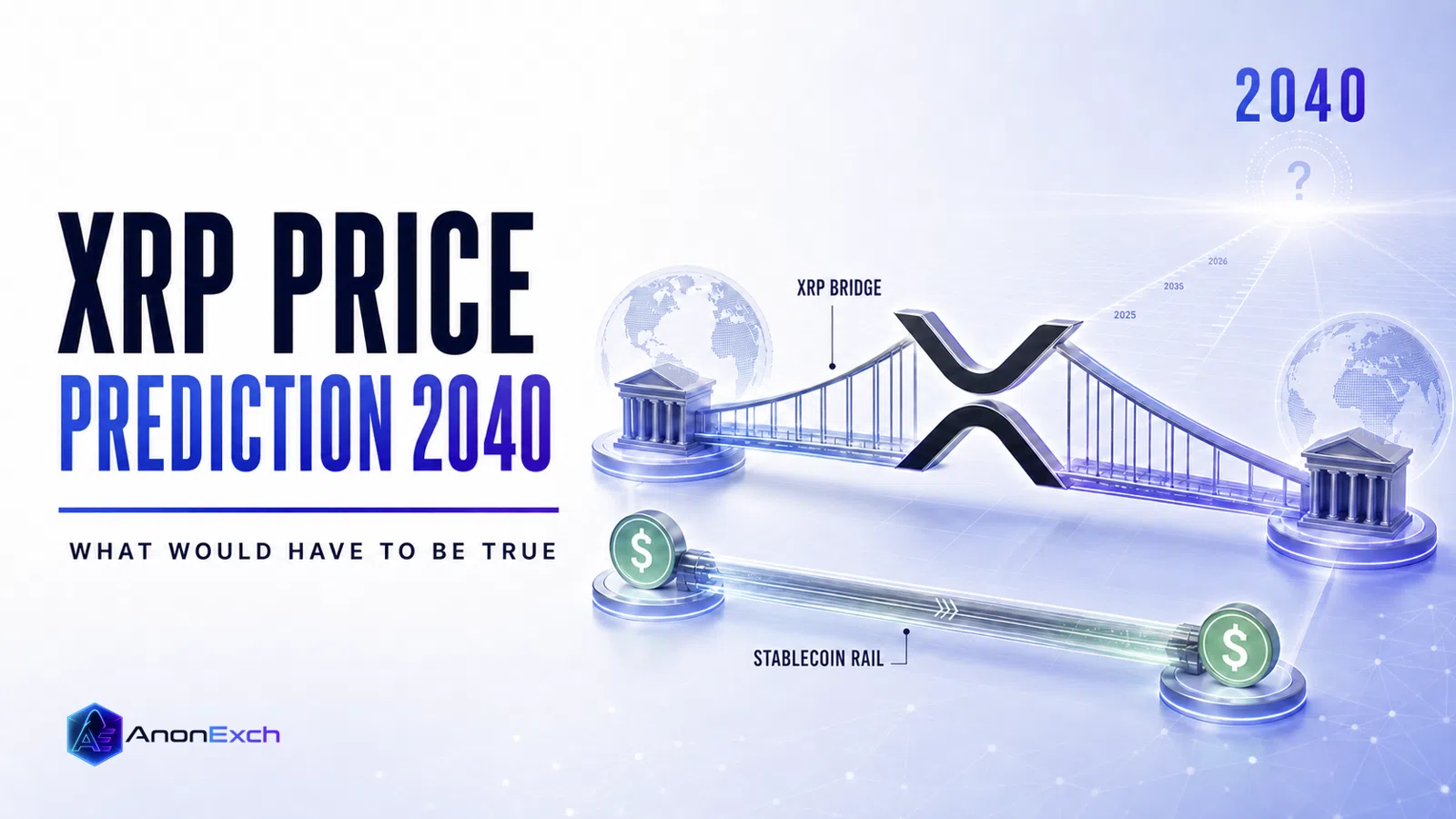
Nobody can forecast 2040. Fifteen years ago Bitcoin was worth nothing and the iPhone was two years old. Any page giving you a precise 2040 XRP target arrived at it by choosing an annual growth rate and compounding, and the decimal places are theatre.
What can be done usefully is to identify the small number of things that would have to be true for XRP to be worth much more, and to be equally clear about the argument that says they will not be. That is what follows. Every number below is arithmetic from an assumption stated in the open, so you can reject the assumption rather than argue with the output.
None of this is investment advice.
Where XRP stands
At the time this page was generated XRP is around $1.35; the live figure is on the XRP page. Supply is the thing to understand before any of the scenarios make sense.
All 100 billion XRP were created at launch. There is no mining and no issuance. Ripple, the company, holds a large portion in escrow and releases it on a schedule, returning what it does not use. That means the float grows over time on a path that is known in advance — a very different property from Bitcoin's diminishing issuance or Ethereum's fee burn, and one that any long-horizon case has to account for rather than ignore.
The thesis, stated fairly
XRP exists to move value between currencies. A bank in one country wanting to settle with a bank in another can pre-fund an account in the destination currency and leave capital sitting there, or it can convert into a bridge asset, move it in seconds, and convert out. XRP is built to be that bridge: the ledger settles in three to five seconds for a fraction of a cent, and one confirmation is final.
If a meaningful share of cross-border settlement runs through that mechanism, demand for the asset is structural rather than speculative. That is the whole bull case, and it is coherent.
The argument against it, which deserves more space than it usually gets
Stablecoins solved the same problem a different way, and they solved it while XRP was in court.
An institution wanting to move dollars internationally can now send USDC or USDT and receive dollars — with no exposure to a volatile bridge asset in the middle, which was always the awkward part of the XRP model. Settlement is fast, cheap and denominated in the currency both parties actually want. That is a genuinely better answer to the specific problem, and the market adopted it at enormous scale.
The counter-argument is that stablecoins need rails, that XRP's ledger can carry them, and that a neutral bridge matters between currency pairs where no stablecoin is liquid. Both points are real. Whether they support a large valuation for the bridge asset itself is the open question.
Anyone giving you a 2040 number without engaging with this has not thought about it.
Three scenarios
Each is arithmetic on today's price from a stated assumption.
Bear — the bridge is not needed. Stablecoins take cross-border settlement, the XRP Ledger persists as competent infrastructure, and the asset trades on sentiment rather than use. Escrow releases continue adding float against demand that never becomes structural. Under this assumption XRP in 2040 sits at or below today's $1.35, and fifteen flat years is a far more ordinary outcome in asset markets than either alternative.
Base — a real but partial role. XRP holds a niche in corridors where no stablecoin is liquid, the ledger carries tokenised assets, and the asset appreciates roughly with the sector. A 3–5x is $4 to $6.75.
Bull — the settlement thesis lands. Regulatory clarity translates into institutional adoption, a meaningful share of cross-border flow uses the bridge, and locked and escrowed supply tightens the float. A 10x is $13.50 and a 20x is $27. Numbers past that imply a market capitalisation worth writing out in full and looking at before believing.
The honest range is an order of magnitude wide. A tighter one means somebody chose a scenario and did not tell you.
The legal question, briefly
Ripple spent from December 2020 in litigation with the SEC. The 2023 ruling distinguished institutional sales from sales on public exchanges, which removed most of the practical uncertainty for ordinary holders. It mattered enormously at the time and it is largely settled now — which means it is no longer the variable that decides the next decade. Adoption is. Do not let a resolved legal fight stand in for a demand thesis.
What no forecast covers
Timing, and what you should do. A scenario that is right about 2040 can be devastating about 2028, and most people who are eventually right sell long before.
One thing that holds regardless of your view: the XRP Ledger is entirely public. Every balance and transfer is permanently visible, and once one address is tied to you the whole history reads in both directions — see is Bitcoin anonymous, which applies here identically. Over a fifteen-year hold that record only grows. XRP to XMR is the route out, and XMR to XRP comes back.
If you are comparing it with the other fast payment ledger, XLM vs XRP covers how much they actually have in common.
Common questions
Will XRP reach $100?
That would be roughly a 70x from current levels, implying a market capitalisation larger than the entire crypto market has been. It is not arithmetically impossible over fifteen years, and it requires assumptions about total market size that are worth writing down explicitly before accepting. Treat any page asserting it casually as entertainment.
Will XRP reach $10 by 2040?
Around a 7x, which is well inside the range of moves XRP has made historically. It is a coherent outcome under the base-to-bull scenarios above — it needs the settlement thesis to work at least partially, rather than only a general market rally.
Does Ripple control the XRP price?
Not directly, but its escrow releases add supply on a published schedule, and it holds enough that its decisions matter more than any single holder's would for Bitcoin or Ethereum. That concentration is a legitimate criticism; the scheduled release is the mitigation, since it is predictable rather than discretionary.
Is XRP a good long-term investment?
That depends on facts about you this page does not have. The answerable version is narrower: do you believe cross-border settlement will use a volatile bridge asset when stablecoins let it settle directly in the destination currency? If yes, the case follows. If no, the ledger may thrive while the asset does not.
What happens to XRP when all the escrow is released?
The float reaches its maximum and supply stops growing, which removes a persistent overhang. It does not create demand. A fixed supply matters only if someone wants the asset; supply mechanics alone have never made anything valuable.
How is XRP different from Bitcoin?
Almost entirely. XRP was created in full at launch rather than mined, settles in seconds through validator agreement rather than proof-of-work, and was designed for payments rather than as a monetary reserve. They are not competing for the same job, whatever a price chart implies.