Is Coinbase Wallet Safe?
Coinbase Wallet and a Coinbase account are two different products with opposite custody models, and most of the confusion about whether it is "safe" comes from treating them as one thing.
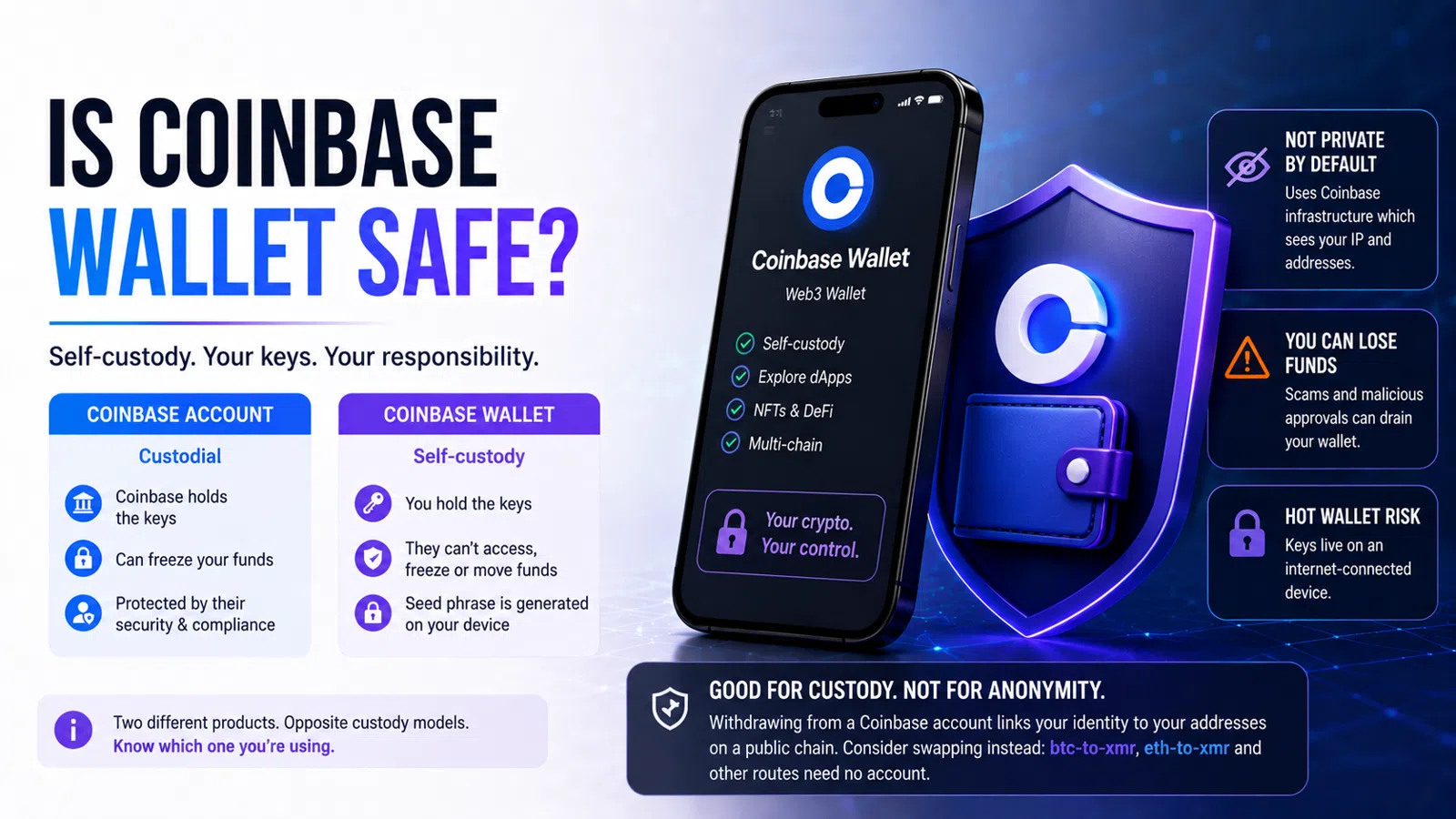
Short answer: yes for custody — Coinbase Wallet is self-custodial, the seed phrase is generated on your device, and Coinbase cannot spend from it or freeze it. No for privacy, in the sense that it is software from a company whose business is identity-verified trading, and its default infrastructure is theirs.
Whether that is "safe" depends entirely on which of those you were asking about, and the question usually hides a second one: which Coinbase product do you mean?
Two products, opposite custody
A Coinbase account — the exchange, on coinbase.com or in the main app — is custodial. Coinbase holds the keys. Your balance is a record in their database, protected by their security, their insurance and their compliance obligations. They can freeze it, and are sometimes legally required to.
Coinbase Wallet is a separate application in which you hold the keys. It generates a seed phrase on your device, Coinbase never receives it, and they cannot move your funds, restore your wallet, or reverse anything. It does not require a Coinbase account to use.
Almost every argument about whether "Coinbase Wallet is safe" is really two people talking about these two different things. The custodial account is safe from you losing a phrase and unsafe from a third party controlling your money. The self-custody wallet is the exact reverse.
What the wallet gets right
The custody model is genuine, not marketing. Keys are generated and stored on your device, it is a well-resourced product with a long track record, and it supports connecting a hardware wallet so the signing key can live off the phone or browser entirely.
For someone leaving an exchange for the first time, it is a reasonable landing place: familiar, actively maintained, and it does the one thing that matters — puts the keys in your hands.
What it does not protect you from
Losing the seed phrase. This is the flip side of self-custody and it is absolute. There is no reset, no support ticket, no recovery. Coinbase cannot help because by design they cannot.
What you sign. Like every browser and mobile wallet, it will execute a transaction you approve. Malicious approval requests — the drainer pattern that dominates losses on Solana and Ethereum alike — are authorised by the owner, not stolen around them. No custody model defends against that.
Being a hot wallet. The keys sit on an internet-connected device. That is fine for a spending balance and it is not what you want holding savings; the fix is a hardware wallet, covered in Trezor vs Ledger.
The privacy question, which is the real one
If you chose self-custody for control, Coinbase Wallet delivers it. If you chose it for privacy, look harder at what the app still sees.
The wallet queries chain data through Coinbase's own infrastructure by default, which associates your IP address with the addresses you hold. If you also have a Coinbase account, and especially if you funded the wallet by transferring from it, the link between your verified identity and those addresses is direct and permanent — the withdrawal transaction is on a public chain forever, and Bitcoin is not anonymous in a way that the passage of time repairs.
That is not a flaw in the software. It is what a wallet from a regulated exchange is, and it is only a problem if it is not what you thought you were getting. A self-custody wallet funded from a KYC exchange is a labelled starting point with good custody after it — see anonymous crypto wallet for the version of this that holds up.
So should you use it?
Use it if what you wanted was to stop leaving coins on an exchange, and you are comfortable with a wallet whose defaults route through a company that already knows who you are.
Choose differently if the reason you moved off the exchange was that you did not want a company able to associate your addresses with your name — in which case the wallet is only half the job, and where the coins came from is the other half. Swapping into a fresh wallet rather than withdrawing to it is what changes that: BTC to XMR and the other pair routes need no account.
Common questions
Can Coinbase freeze my Coinbase Wallet?
No. They do not hold the keys and cannot move or lock the funds. They can stop offering the app, which is why your seed phrase matters — it restores into other wallets and is the actual thing you own. A Coinbase account balance is different and can be frozen.
What happens to my crypto if Coinbase goes bankrupt?
Funds in Coinbase Wallet are unaffected — the keys are yours, and the seed phrase works in any compatible wallet. Funds in a Coinbase account are a claim against the company, and how that resolves in an insolvency is a legal question rather than a technical one. This distinction is the entire argument for self-custody.
Is Coinbase Wallet better than a hardware wallet?
Different jobs. Coinbase Wallet keeps the keys on an internet-connected device, which is convenient and exposed. A hardware wallet keeps them on a device that never goes online. For a spending balance the wallet is fine; for savings, the hardware wallet is the answer, and the two work together.
Does Coinbase Wallet require a Coinbase account?
No. It can be installed and used with no account at all, which is worth doing if you would rather not have the two associated. If you link them or transfer between them, the connection is made and is permanently visible on the chain.
Is Coinbase Wallet anonymous?
No. It does not ask for identity documents, which is not the same thing. The app's default infrastructure sees your IP alongside your addresses, and any transfer from an exchange account ties those addresses to a verified identity on a public ledger. Not requiring KYC and being anonymous are separate properties, and only the first is true here.
Which is safer, Coinbase or Coinbase Wallet?
Neither, in the abstract — they fail in opposite directions. The exchange protects you from losing a phrase and exposes you to a third party controlling the funds. The wallet removes the third party and makes the phrase entirely your responsibility. Pick according to which failure you can actually live with.


